Showing posts with label Young Adult. Show all posts

Tuesday, December 30, 2008

James and the Giant Peach


I shouldn't be allowed to read classic children's literature. My brain simply doesn't appreciate its intended purpose - creativity, imagination, fantasy. Instead, I wonder, "What's the point here?" Sometimes, there is a point, but I think with Ronald Dahl, the focus is placed on the magic and if there happens to be a story in there somewhere in it..so be it.

I borrowed it from the library because it was on the most-commonly-banned-books-in-America shelf and I wondered how the author of Charlie and the Chocolate Factory could upset so many modest American readers?

I still don't know. Unless there is some upsetting symbolism that went way over my head and would be sure to go over the head of its intended audience, I don't understand how this book could offend anyone but mean, crusty old aunts who don't love and take care of their orphaned nephews.

That being said, I wish I loved this non-controversial story, but I didn't. I thought it was overly strange. Strange in a did-you-write-this-while-tripped-out-on-LCD? kind of way. Giant talking bugs. Living in a peach. Flying over the Atlantic Ocean with the help of string tied onto 501 seagulls via the giant silkworm and spider. Landing on the needle of the Empire State Building in New York. A ladybug marrying a police man (What the?). O.K then.

James was surrounded by mean, nasty aunts and now he's happy and living in a giant peach in New York City's Central Park. Wildly imaginative but famous through the ages?

To make sure it deserved its fame, I had my eight year old son read it (even though the word a** is in it twice. Why did Dahl do that?) and he liked it. He didn't love it. Not because it was strange but because like most things he reads, the characters are magical and the plot bizarre. For him, it seemed almost standard fare. When he finished, he handed it back to me and I asked, "Did you like it?" "Yeah." That's it. No buzz. No acting out parts of the story and certainly no regurgitating details from it like he does with some of his other books.

I guess we're just a bunch of fuddy-duddies around here because I found nothing extraordinary about James and the Giant Peach except it's eccentricity.

Friday, October 24, 2008

Breaking Dawn


I've decided that as rich and famous as Stephanie Meyer is, I would never want to be her. I don't believe I've ever read about any other author who has sold as many books as she has, but has also been as harshly criticized as she has been. As likely as it is to find someone who stays up all night to finish her books, it's just as easy to find someone who hates her writing, hates her characters and pretty darn near hates anybody who reads her books.

As in most areas of my life, I am a Stephanie Meyer moderate. The right makes me shiver with their extreme obsession and devotion and the left gives me a head ache from all the eye rolls I'm forced to do after reading overly critical reviews.

Breaking Dawn brought the Twilight series full circle for me. I'm not even going to bother with a recap because if you don't know what it's about by now, then you can't possibly care about what I'm going to write. I excuse you.

With all my up-to-date hindsight, I can say that I really enjoyed Twilight, was disappointed with New Moon, was slightly confused and cared less about Eclipse and thought Breaking Dawn did a satisfactory job of tying up some of the more important loose ends.

Finally, finally....Bella gets to have sex with Edward. Phew! I'm so glad Meyer got it over with at the beginning of the book instead of drawing it out for another 500 pages. She writes it modestly, honestly and kept it what all married sex should be....private. I could say more, but suffice it to say, I appreciate Meyer keeping it real. The passion was there, the awkwardness and anxiety ever present, but most importantly, the love and fun were there too.

Like a lot of readers, I found the "Jacob" chapters boring. I have never felt the connection between Bella and Jacob and only believed it because the author kept telling me, again and again and again, that they had one. So they had one and it felt even more unbelievable and creepy after Bella was married. Considering the ending and the birth of Edward and Bella's baby, Reneseme (worst baby name ever, I believe) I understand the need; we need to believe Jacob's devotion to Bella and live through his own confusion over it, in order not be completely disturbed by Jacob's subsequent devotion to Reneseme. Still, it didn't make for great reading.

I really liked the end. I liked the happy ending. I liked the other vampire characters and the description of their cool gifts. I liked that the good guys won. That is young adult literature. Good triumphs over evil! Stand up to the bully! Work together and accomplish the impossible! Mostly, I liked Bella being a vampire. Finally, she was comfortable in her own skin and it actually made her likable. Perhaps, Meyer meant to have Bella annoy us readers through three long books so that we could see the improvement when Bella makes the transition from mortal to immortal, although I doubt it. Meyer is a genius at writing conflict - not characterization.

My greatest complaint was that Edward never got back to being Edward. I'm going to have to accept the character she gave me in books 2, 3 and 4 and forget about the interesting and better developed Edward from Twilight, who has never reappeared in any of the sequels. Oh well.

Oh, and the word, "Ugh". Nothing screams false like an angry teenage werewolf feeling frustrated and shouting, "ugh!". I'm not promoting obscene language or anything, but...really? Ugh?

I'm glad she releases her books in the summertime, because Breaking Dawn is an enjoyable summer read.

Wednesday, May 21, 2008

Hope Was Here


I feel like the big grown up bully attacking the cute, freckled face kid on the playground with this review. However, as a Newberry Medal Honor Book, the playground kind of turns more into a raquetball court and the kid has to be good to play in it. Consider me goggled, racquet in hand, and donning my wrist sweat bands for serious play.

I really don't understand how this is a Newberry Medal Honor Book. The characters were flat and one-dimensional, the plot predictable and the message was dangerously simplified. I'm left to guess what age group Bauer wrote this for. The abandonment issues the protagonist, Hope, experiences are too mature for young elementary age and older, middle school and high school aged adolescents certainly can grasp the concept of a flawed character or even impure motives. She most certainly didn't write it for a 32 year-old moderate who found the obvious bias of kind-hearted liberal vs. heartless, evil conservative over-the-top and unhelpful for any honest discussion about politics.

I didn't hate it. How can you hate G.T. and his good-guy-leukemia-fighter-town-fixer-upper-cook self? I couldn't. I couldn't even hate Hope, and her far-older-than-actual-sixteen-year-old-mentality even though I never understood her, or her motivation to become so politically involved (because the author never let us know that. She just wrote Hope that way).

I'll take off my goggles now and lob poor freckled face a few serves. It was a nice story. The boy got the girl. The good guy wins. The food was good and hot. The end.

Tuesday, April 15, 2008

Princess Academy


I enjoyed this so much more than I was expecting to. Shannon Hale keeps surprising me and I think this the best of all her books I've read. Of course, Austenland has a different target audience, so...really, I can only say that this outranks Goose Girl.

I hate the title. It reminds me of a Disney movie that stars Amanda Bynes or Anne Hathaway or somebody that little girls want to grow up to be like. The title actually kept me from reading this earlier. It sounded silly. In reality, however, the title is completely appropriate (I certainly can't think of a better one) and a great book for girls and their moms (sorry guys, but I don't think you'd enjoy it).

Mira is a fourteen year old Danlaner who lives on Mt Eskel with other mountain village families. When the prince's representatives come and announce that the prince will choose a bride from Mt. Eskel, each girl between the ages of 13 and 18 are forced to leave their families and attend the "princess academy" where they learned to read and write and learn the basics in commerce, poise, conversation and dance. After a years time, they meet the prince but Mira also realizes how much more enlightened she is with her education - princess-to-be or not. She uses her knowledge to better her village, defend her family and figure out the secret of "quarry-speaking".

Part fantasy, part romance, part coming of age, part fairy tale, I enjoyed this quick read.

The Witch Of Blackbird Pond


I know this is a classic. A Newberry award winner for juvenile fiction, I can hardly criticize such a loved book. Sadly, I did not read this when it was meant to be read, as a youth struggling to know it's more important to do the right thing than to fit in with what everybody else is doing.

Important, worthy lesson, but after reading two young adult novels this week with very similar themes (does this happen to anyone else? I always seem to inadvertently read books in "themes"), I feel there is something lacking when an adult reads young adult literature. Innocence, perhaps. It's too simple. The protagonists don't fit inside the story. They are almost always ahead of their times and privy to understanding that their peers don't seem to have access to. Where did Kit come from? Barbados, yes...but possibly from the 20th century as well? As modern readers, we have the hindsight to see and learn from the foibles of our ancestors and their limited understanding, but the author gave this sort of vision to Kit immediately.

I don't know if this is ever argued (and why am I arguing, didn't I promise not to?) but part of me feels like there is an anti-obedience theme in this book. Kit is almost always disobedient, and her disobedience always turned out to be the right thing to do. Because it's young adult literature, everything turns out fine in the end, but there is a difference in doing the right thing and doing what you want to. This is a much deeper discussion to be typed out here, and I won't blaspheme this good book any more. I know it's a favorite.

The Raging Quiet


A novel for young adults, this story highlights the struggle of an ahead-of-her-times girl, Marmie, and her new deaf friend, Raven, who is believed by all of the rest of the ignorant townspeople to be a madman.

Marmie meets Raven when she is brought to the town as a young bride on her wedding day, married to Isake, a lord more than twice her age. She notices Raven being beaten by townspeople as she and her husband ride into town on their wagon. While waiting for her new husband to finish getting drunk in a tavern outside in the rain, Raven approaches her bleeding, hungry and scared. Not at all intimidated, she offers him food and their unusual friendship begins.

Fortunately for her, after two days of not quite so wedded bliss, her husband falls from the thatched roof he is repairing and is killed. This leaves her free to develop her friendship with Raven, discover that he cannot hear, and begins her quest to teach him how to communicate by using signs. I found this troubling. Surely he was not the first deaf person in all of Europe. I didn't know why they found him so scary.

Set in medieval Europe, when witchcraft was feared and those with birth defects were considered evil, Marnie saintly and stubbornly teaches the young man "hand talk". When the townspeople (apparently all uncharitable and bad) see her using hand signals to him, they are convinced she is a witch and has put him under her spell.

I understand why these books are written. Yes, I suppose I can apply the moral of the story to our own day and recognize the universal lesson that just because people are different doesn't mean they are bad. Unfortunately, I think I'm too cynical for some young adult fiction.

This book was too simple and the characters entirely too boxed in. Marmie, is always selfless, always determined, always fearless and always right. The other characters were ignorant, mean and sneaky. I just don't enjoy the lack of subtlety. Few characters should so easily fall into a good or bad category as every single one is (or should be) flawed.

I think there are better books out there that tell this story better. But maybe not for young people. I don't think I'm the best judge.

My Thirteenth Winter

This book was a complete surprise for me. A few weeks ago, my mother sent me an email which included a beautiful quote from this book. It was about being a writer, and my mother was paying a compliment to me in regards to my dedication to blogging. Interested in reading the book where the quote came from, I found myself reading about a very bright girl whose world collapsed around her as she struggled through her elementary school years with an undiagnosed learning disability.

Samantha Abeel was a bright, precocious and highly confident young child. Her memories of Kindergarten and first grade are of being in the top of her class and proudly so. She knew she was known as one of the smart kids and did her best to live up to her reputation, even as she inwardly began to realize that sometimes, particularly during math time, she had to fake it.

As her school years progressed, and she couldn't keep up with her peers in math, and she couldn't admit that she had no idea how to tell time, she turned inward in humiliation and depression, while secretly praying that the difference was merely because she was special and wise, and not at all slow.

After many unfortunate delays and misdiagnoses, Abeel was finally diagnosed with a math and sequencing learning disability known as dyscalculia. Throughout her schooling, Abeel realized that although she couldn't understand the rules of grammar and had a hard time spelling, she had a gift for words and poetry and channeled her gift into a skill of writing. As a ninth grader, she, with help from several teachers and artists, published a book whose name was later changed to Reach For the Moon. While it gave her confidence and success, she still drifted into social isolation and depression throughout high school and later, college.

Reading about her change, her isolation and fear, made my heart pound as I thought about the possibility of any of my own children suffering in this way. Particularly Henry, as we continue to worry about whether or not his speech will come or if it will be a continual battle for him throughout his life.

The faults I have with this book lies in its slow, repetitive pace. As the story begins with her memories as a kindergartener and ends with her graduating from college, it's got more than enough "space" for her memoir, the sort of book usually reserved for a later time in life. Additionally, Abeel frequently transitions the style of writing from autobiography to memoir, which sometimes works but often times feels incredibly jarring. It's like she's a narrator to her own memories, but without first giving a warning to the reader to "fade to screen".

Aside from that, I think this would be a valuable and worthwhile book to discuss. From our current education model to the causes of depression and its treatment, I think many women, mothers and friends could relate to its material. I also think it would be a good book to recommend for older children with learning disabilities or their peers.

And, now, for the quote that started it all, which is actually quite relevant to her own story, but also a beautiful passage for anyone who enjoys writing.

For an admissions essay to Mount Holyoke College, she writes:

Sometimes on winter mornings, I try to see myself in gathered wrinkles, my dark hair forsaking me to silver. I try to see my hands traced by blue veins and my eyes in vintage brown. I try to see myself a little bent, a little withered. I close my eyes and see me all in white, all in gray, draped in the webs of age.

Oh, I will ache a little and have one of those chronic coughs. I will sit in my chair and pull at curtains that reveal a window etched with white doves of frost. Then, maybe just then, I will know what I was and who I am. I will know all that I took and all that I gave.

It is here that I want to be a messenger, a courier of everything I've gathered. I want to tell my grandchildren of the games my friends and I would play. I want to pass on the legends that creep around us. I want to tell them of the sand dunes and of the lakes. I want to tell them of the many ghosts that look fondly upon them. I want to say that I have made a difference. I want to give them the world through my eyes.

However, for now, my center, my sense of self, my purpose is yet unclear to me. I see it like one sees a fish in a river, only silvery flashes of fin and tail. Never seeing all of it at once. The journey to discover these things lies ahead. When I am in the November of my life maybe then I will understand my June. I do know that I want desperately to understand what I don't, and give the understanding of what I do to others.

Perhaps one day, after I have sunken into the shadows, my granddaughter will read one of my poems to her daughter, or show her a book that I collected, maybe even pass on one of the stories that I told. Then, there in that moment, is all that we can ever hope to be. That one little niche in time, when what we gave, or passed on, is given again.


I could never say it quite so well, but this is what I hope too.

The Subtle Knife


I am not a fan of forwarded emails. They frustrate me, because they usually come from the same group of people, people I like a great deal but who never send me a normal "hey, how's it going?" message. Just "Support our Troops" or "Tell every woman you know she's special" or "Microsoft is running a test and if you send this you could get a check for $1,000!" When I see the letters FWD in the subject line, I usually simply delete it.

I lost track of the number of emails I received telling me about the Anti-God movie The Golden Compass and the need to boycott the movies and the books. It was well over ten. Ten people wanted me to send that email on to everyone I know, telling them the same thing. Don't see this movie! Don't read these books! Alert! Alert! Alert!

Nothing like calling attention to something like a planned boycott. I haven't seen the movie, because I'm cheap and it's not something I'd take my kids to or something I'd be prone to see anyway, but as I had already read the first book in the series, enjoyed it and hadn't found it to be Anti-God, I was curious to read the next to see what the fuss was all about.

I don't know if the emails worked and I read with a bias, but I did not enjoy this second book. Not because it is Anti-God...which it really isn't, but more anti organized religion and organized religion's version of god, but because the writing is bad.

Dialogue - choppy.

Descriptions - cliched. (how do I get that little accent marking over the e?)

Storyline - totally falters.

I felt enormously disappointed in the direction of this book. Lyra, the young female protagonist in search of dust and her father, all but disappears in this second story. She still plays a part, but now as the sidekick to Will, a new character who is a giant "young adult fiction" stereotype (in search of the father he never knew while protecting his mother from bad guys and seems to be gifted in the combat department). I don't remember the writing being bad in the first book. I thought it descriptive and unique and thoughtful. Not so, in The Subtle Knife. Pullman changes gears and loses focus. There is a lot more going on and none of it is developed well. I stopped caring about the characters and their goals.

I think these books had great potential. There could be a lot to discuss with adolescents (not young children...at all). The nature of the soul, the natural man, the costs and benefits of religions. All appropriate things to discuss with youth ready to question and discover on their own.

Pullman takes that conversation away with his lack of metaphor. It becomes impossible to argue, "I think the dust means this." or "what do you think The Authority is for Pullman?" when he throws his opinion at you with real life Christian beliefs. It's inappropriate and unfair. Write a fantasy or a satire or a parable if you want to. Other authors have done it...and done it well.

Pullman didn't.

I won't be reading the third book.

Goose Girl


Poor Shannon Hale. I think the most frequent comment I've heard about her as an author is, "She's LDS and like Stephenie Meyer, doesn't write LDS fiction."

I'm not sure it was a good enough reason to check out her book, Goose Girl, but I did it anyway. My sister, Jen, liked this book and that was one more reason, but a good enough one for me.

It was a nice break from some of the meatier stuff I've been reading. It's not meatless, exactly, but written as a fairy tale in the voice of a young princess so it's about as meaty as Chicken Noodle Soup.

There are some worthwhile themes throughout the book. Ambition, gifts, honesty, work. The princess, whose name was blessedly shortened to Ani for most of the book, lacks the power of persuasion that her mother, the Queen, possesses. The author calls this gift "People Speaking" and while Ani doesn't possess that particular gift, she does possess the rarer, and less esteemed "Animal Speaking" and later "Nature Speaking" gifts. She can talk to swans, as a girl, and later, while in hiding when her lady-in-waiting pulls a coup during their journey to meet her betrothed, learns to speak to the geese she keeps. Ultimately, she uses these gifts, especially her ability to talk with wind, to restore her place as Crown Princess, leaving us with the lesson that we can rely on the gifts we possess to accomplish what is necessary. I think. At least, that's what I'm taking away from it. A la....To Thine Own Self Be True without all the fancy talk.

Those elements create the fairy tale, as well as all the prince and princess stuff, but this felt surprisingly modern to me. There were times the dialogue seemed appropriate to the time of the story, but most of the time, I heard the voices of young, spoiled American teens in my head, especially when the ruthless Selia spoke.

In any light, Goose Girl is an easy read, with some sound moral backbone - as fairy tales usually have, but isn't incredible literature - as fairy tales usually aren't. But sometimes, it's nice to simply read a good story. Goose Girl is that.

The Golden Compass


This series, written by Philip Pullman, was recommended during my reading rut by Anne and I have to say that I am so glad for her recommendation. I don't think I would have picked it up, otherwise, and this was highly enjoyable reading for me.

The series is called His Dark Materials, and The Golden Compass is the first book in the series. In it, the main character, Lyra, an eleven year-old girl, is introduced. Also introduced is the idea of daemons, which, while never actually explained, I'm going to describe as a kind of soul for human beings. Each person has a daemon, which is an animal who is with its person at all times and sort of reveals the mood and character of their human partner. Childrens' daemons can change, and do depending on need and situation. Lyra's daemon, Pantalaimon, changes between a moth, when Lyra is trying to hide, a lion when she's trying to intimidate someone else, and everything in between. I absolutely loved the symbolism it provided throughout the entire story.

Lyra is given an alitheometer, which is a truth telling compass that, through a series of needles, point to objects symbolizing the answers to questions she asks. No adult knows how to read it, and Lyra herself seems unaware of the great gift and power she possesses. Again, lots and lots of symbolism.

While this is billed as young adult fiction/fantasy, and has all of the exciting story lines that would provide hours of amusement and discovery for that age group, this plot...this idea is so complex that any adult should enjoy it. The dark materials, Dust, is viewed by some in the Church as evil, only because it is misunderstood, and therefore to be removed and destroyed. Experiments have revealed that Dust surrounds adults, but not children, and a theory is proposed that it settles only when a person's daemon becomes permanent and cannot change anymore. To test their theory, the group of researchers funded by the church, kidnap children of the poor and experiment "cutting" away their daemons so that this process can never happen. The children are left soulless and all die from confusion and shock.

Incredible analogies, fascinating settings and fantastical characters make this series one I look forward to reading!

The God of Animals


Alice Winston is a 12 year-old girl whose dysfunctional and isolated family life has left her unable to cope when a classmate of her dies. Her father, Joe Winston, a horseman with too many of his own problems to worry about his daughter's, leaves her emotionally starved and physically overburdened. He doesn't notice as her clothes become too small and too tight and expects her to muck the horse stalls, take care of the horses and help out with her clinically depressed mother who hasn't left her bedroom in over a decade.

In this burdensome environment, her sixteen year-old sister elopes with a rodeo cowboy creating an even wider gulf between Alice and other girls her age. Sheila, a girl her age but from the other side of town, starts coming out for riding and showmanship lessons. The family financially depends on this girl and her money, forcing Alice to befriend Sheila although she has few of the necessary social skills to do so.

As the family business struggles financially, her father submits to what he calls his last resort and allows other people to board their pedigree horses in their barn. A group of rich women, dubbed the Catfish by Alice, start coming too frequently to socialize, ride their horse and drink out of paper cups and one of the women begins a dangerous flirtation with Alice's own emotionally starved father.

There are so many things I enjoyed about this book. The writing is beautiful and the author, Aryn Kyle, does an amazing job weaving in the landscape and weather to amplify the mood and the world of horse breeding and shows as the catalyst for Alice's coming of age. This would have been a much different story if told by her father, or her mother or even her older sister. But it was told through Alice and we understand her low self-worth, her confusion and desire to please, her ultimate need to know that she was being taken care of. I wanted to reach through the book and hug her and reassure her that she was doing a good job and that I noticed. All she wanted was to be noticed and accepted for who she was and what she was good at.

A haunting family story with a beautiful but harsh landscape, Alice grows up understanding that dreams don't always come true, the good guy doesn't always finish first and that nature can be cruel.

Eclipse


This is a warning to anyone who doesn't even want to look at a review of Eclipse until they've read it. Repeat, this is a warning. If you want to know nothing about the novel, look away (Chloe...I gave you fair warning!)

Here are my feelings about the third book in the Vampire series by Stephenie Meyers. Bella bugs. She really, really bugs and everyone lets her get away with it which ticks me off. I can hardly stand to be in her head when she narrates. And yet....

I loved it. Why? I have been asking myself that for over a day now, because most of these characters annoy me to no end, the writing isn't really that great, the dialogue downright cheesy and the story didn't progress enough for a book that was over 500 pages. I think the answer is that this story, this dangerous love story between Bella and Edward, evokes an actual physical response from me when I read about them. I guess I enjoy the tightening in my chest and the flipping of my stomach. I also love the conflict, the setting and the fantasy.

I don't know what to say about Bella. She is, by far, the best developed character in the series. We get to know her thoughts, her motivation, her reasoning and even though I think the author wants us to, I still really don't like her. She is suppose to be so mature for her age (would never let her mother jump out of airplane, because she is the parent figure in that relationship) but has some completely irrational and irritating need to suck the joy out of anyone who tries to do something nice for her, like give her a gift. That doesn't fit in with the personality of an old-soul. She's moody and unreasonable and I can't figure out why everyone wants to be around her because she seems like a downer to me.

Edward has been my favorite character throughout the last two books (even though he was disappointingly absent for much of New Moon and then when he was in it he could have been mistaken for Eeyore), but I don't think she progresses his character at all in the way she originally developed him. Edward was kind of the rebel/bad boy of the vampires in Twilight. There, he was independent and reckless, willing to take a huge risk by giving in to his attraction to Bella. Even though he was attracted to her, he still managed to show some personality. He was kind of sarcastic, enjoyed watching her squirm, a bit with his non-human abilities, and WAY more lighthearted than the uberprotective boyfriend he has turned into. I think he could still play a little more hard to get and independent. I think he needs a responsibility besides protecting Bella so that he has some of his own conflict. He at least needs to get mad at Bella when she deserves it.

The other characters are equally flawed, but not in the way that makes them believable. Jacob should be more jealous. Physically, he may have aged to 25 through his mutation, but emotionally, he is sixteen. Sixteen year olds don't always see the big picture and I think I would feel their connection more believable if there was more than their past friendship that left Edward out. Bella and Jacob have much more in common than Bella and Edward do, and their commonality should be the connection between them, not Bella's compassion or concern for Jacob's pain at becoming a werewolf or gratitude for his friendship when Edward left. I think the author tried to show their like-mindedness at times, like riding motorcycles (the ONE time Edward feels left out - but of course he handled it like a champ) but she didn't go far enough. It would make much more sense in the end when Bella realized she was in love with Jacob too. I think the author forced a realization that wasn't really there.

I liked the love triangle but never felt that Bella would, could or should choose Jacob. Edward was always the better choice and as we knew Bella's mind, we knew that he always would be. I can see what Meyer tried to build up for the next book, but unless Edward does something drastically to change, like gets a big ol' hard pot belly, Bella would never choose not to be with him. There is no competition. With all three books, that point has been hammered home.

Outside of the story, I have to mention my slight annoyance at Meyer's indifferent attitude towards her responsibility to her LDS teenage fans. She has to be aware of the craze that she has started. I had heard about it, but it really is a phenomenon here in Utah. I think her success is independent of her LDS background, but I do think when people, parents particularly, have that knowledge, they feel a little more safe allowing their children to enjoy these books. She actually reminds me a bit of Benji, from So You Think You Can Dance. I think it would be a horrible thing to become famous and be LDS. Automatic ambassadorship without being asked. As Benji horribly disappoints in that un-appointed ambassadorship, so does Meyer with this book. Teenage girls who read this will be exposed to another teenage girl who repeatedly thinks, says, feels that if you believe you're going to be with someone for forever, marriage is unnecessary and old-fashioned solution to progress a sexual relationship. It is only Edwards old-fashioned virtue, maturity and control that keeps Bella chaste. And her chastity annoys her. What a great message for girls who might be struggling with a similar situation. Chances are good, however, that most of the seventeen year old boys they want to be with don't have Edward's point-of-view. It's irresponsible to let the brakes be in someone else's power. But, like I said, Meyer certainly doesn't wear a Mormon badge and I don't think I'd judge another author harshly for doing the same thing. With my own awareness, though, I think she disappoints in this regard.

Eclipse is better than New Moon but Twilight is still my favorite book of the three. Regardless of ranking, Eclipse does its job and kept me entertained for hours.

Harry Potter And The Deathly Hallows


I think most of you know how this ends by now so I'll just say that I think....

I wouldn't do that. Maybe I'll do a real review of it in a few weeks but it wouldn't be fair to disclose all my thoughts about something that is best read with the secrets still intact.

I really liked it. I think this entire series is great. I wish my boys could discover them when they turn eleven and then just read one per year as the content, language and plot all mature with the characters. But, mostly, I hope that they enjoy this wonderful world of imagination, magic and mystery as much as their old mom does.

New Moon


I decided I had had enough waiting and went and bought this book at Wal-mart. Is it only in hardcover? Well, I'm hooked up now because along with the hardcover price, I also now have my very own tattoos of Bella's name, Jacob's name and Edward's name, not to mention a tattoo of the book cover art. Totally stoked about that (just trying to sound like the young adult the author geared these stories towards).

I am glad I bought it. It was the kind of book I couldn't put down. I started it in the morning and finished it in the evening. Obviously, it deserves kudos for being hard to put down. It's great. But, at the same time, it's not GREAT, but I think that's because it's young adult fiction so it still isn't something that I can totally admit to loving without any reservations.

New Moon is the sequel to Twilight and apparently the middle of Meyer's Edward/Bella trilogy. Her last book, Eclipse, is due out next month. The book starts with Bella turning 18, a birthday she despises because she is now a year older than eternally 17 Edward. She is not excited, at all, about any celebration of her big day and grudgingly goes to a birthday party thrown by Edward's sister, Alice at their big vampire mansion in the woods. She gets a paper cut opening one of her gifts and one of Edward's brothers (they aren't actually related but have all lived together for years and years under the leadership of Carlisle and Esme - their parents - who have created this non-human blood diet which makes them more humane) attacks her on whiffing her highly desirable, fragrant blood.

This freaks Edward out, again, that she is constantly in danger around him and he lies and tells her that he doesn't want to be together anymore. Bella is devastated.

The rest of the book deals with her devastation. I suppose it's possible for young people to experience that kind of all-consuming love. I know teenagers themselves, think they are constantly experiencing it, but it's the 30ish me that realizes in hindsight that that consuming feeling, that intense desire, isn't necessarily that eternal, end-all, be-all love. There's my skepticism. BUT...now there is romance unfulfilled and lots of tension as Bella tries to move on, develops a strong friendship with Jacob (who has a surprise of his own) and cope with her great loss.

Not enough Edward in this book, in my opinion, but it was a great set-up for this last book where it will be decided if Bella herself will become a vampire (her greatest desire) and what will happen when Edward and Jacob finally have to duel. I admit to being totally and completely hooked.

Twilight


My sister in law, Tara, let me know about this little gem. I had never heard of it but it is a very successful book. New York Times Bestseller. Moreover, it's written by an LDS author. The book has no ties, at all, to our beliefs. It is a love story between a high school girl and a vampire. Not exactly what last week's sunday school lesson was about:)

Still though, it's a good book. Clean. I was very surprised that I liked it as much as I did. First of all, it's young adult fiction. I keep hoping I am too mature for young adult fiction, but I'm not. I loved all the high school drama. Even more surprising, I was totally drawn into the relationship between Edward and Bella. I couldn't believe it. Hello...he's a vampire! Who am I rooting for?

I rooted for the vampire. Even more than I rooted for Bella who wasn't balancing her attraction to Edward with a desire to kill him. Edward is a good guy who controls his urge to kill humans by feasting on wild animals. I know...PETA would be appalled, but it is a moral step up. He is eternally seventeen, because that was when he was bitten and became a vampire (it was humane), but he was born in the early 1900s. Once the author, Meyer, exposed that part of his character, I felt it allowed her to write Edward as the old soul he was. He no longer seemed like a seventeen year old boy, which he kind of did at the beginning of the story. Mentally, he was an adult in my mind.

While the love story is interesting, the story really grabs the reader when it turns into a thriller. Bella is discovered by some other vampires and one in particular decides to track her. Now you have vampires fighting vampires and it's just...exciting.

Fun, fun read. And there's a sequel! Yay!

Thursday, April 10, 2008

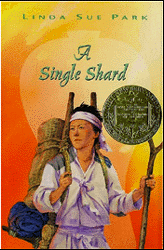
A Single Shard

This is a 2002 Newberry Medal Award Winner in Juvenile fiction. It is a story of a 10-year old, homeless orphan named Tree-ear in 12th century Korea. He lives under a bridge with another homeless man, Crane-man, who has taken care of him for years. They struggle to eat and stay warm but this 10-year old has a secret indulgence...he goes and watches a master potter work at his wheel. One day, he finds the potter gone but notices several of his pieces drying on a shelf. He goes in for a closer look and when the potter finds him there, he startles and knocks a valuable piece off the shelf and it breaks.

To pay the debt, he works for the potter but once his debt is paid, asks to stay on and work for him in hopes of one day becoming his apprentice. But in Korea, apprenticeships are passed down father to son and this orphan realizes he'll be left out once more.

This is a wonderful, easy read about love, hard-work, patience and perseverance. It is uplifting literature.