Showing posts with label S. Show all posts

Tuesday, December 30, 2008

Skeletons at the Feast


I know it seems baffling to be writing book reviews on Christmas Eve. But, the presents are wrapped, the house is relatively clean, the laundry is spinning, the boys are playing and I need to get these books out of my head so that I can relax. I do enjoy writing them, but when I get backlogged, I can feel a little overwhelmed by all the characters and plots in my head.

Skeletons at the Feast took me to a dark place - the Holocaust. If there weren't so many great books written about this black mark of the world's history, I would ban myself from reading any books on this topic in the future. I hate that such a horrific occurrence is repeatedly used as bait for novelists.

Bohjalian is a good author, though, and does a good job developing his characters, giving them interesting conflict, all the while threading bits of real history into his story that he obtained through diligent research. I'll give him credit for all of the above.

However, part of me felt like Bohjalian decided this was going to be his one and only time to write about the Holocaust so he was going to put it all in one book. The details he gives about the atrocities committed by the German soldiers, the Russian soldiers and the desperate and destroyed left in their wake is so graphic, so skin-crawling brutal that it borders on gratuitous. Including as much as he does has the opposite effect from the one I imagine the author intended and his book almost becomes a WWII caricature. I'm not saying the things he describes didn't happen. No, he seems to have read enough journals and letters to give each horror story credibility, but to include them all -- in the same book, witnessed by the same characters in the space of about a year -- it made these disturbing acts of cruelty seem made-up. I feel it was a disservice to take someone's real life nightmare and diminish it by setting it alongside so many other nightmares so that they all seem somehow....less. Because that is what happens. The first description was like a punch in the stomach, the next a slap on the face and all the rest...swats on an already numb backside.

As much as I wanted to, I didn't dislike this book. Bojahlian creates a complicated story about the fallout from ignorance, naivety, and privilegefound among the rural aristocrats of Poland and Germany near the end of the war. Not forced to witness the daily disappearance of Jews and other minorities, the Emmerilich family was living in relative peace and prosperity, along with their polite relationships with the POWs helping out on their beet farm, until the ugly consequnces of their fuhrer's decisions found their way to the family's country manor, Kamenheim. Anna, The Emmerlich's teenage daughter, falls in love with Callum, a scottish POW, and convinces her parents to allow him to remain with their family instead of sending him back to the prison camps. As Callum and the Emmerlichs flee the approaching Russian troops, the blinders of this family's eyes are removed and they finally see first hand the destruction throughout their land. Along their west-bound journey, they meet and become dependent upon Uri, a young, vigilante Jew posing as a German soldier in order to survive. There is an additional, competely separate story involving a french, Jewish girl named Cecile who is trying to keep herself and her friend, Jeanne, alive while prisoners in a concentration camp that does eventually intersect with Uri and the Emmerlichs but not soon enough to be satisfying

There are plenty of lessons to learn within the pages of this book, but I can't say that it is one I recommend. The author tries to write too many stories at once-- a romance, a look at Nazi sympathizers, stereotypes the Polish people had of Russians, allied prisoners of war, a coming of age story, the gore and sadism of war, Jewish resistance, Jewish survival and an unnecessary epilogue, to make this novel truly great.

So Brave, Young and Handsome


I love Leif Enger's writing. It's almost like he has some sort of program akin to Photoshop for writing - and manages to edit words so that they're softer...more pleasant than the picture he's describing. This whole book has a romantic, old-west feel that immediately snagged me. Even though I had already started another book, the opening chapters of So Brave, Young and Handsome swept me up and into its narrative.

It begins with a former postal worker, Monte Becket, painstakingly trying to write 1,000 words a day to produce the follow-up to his first surprisingly successful debut novel. His son and his wife patiently wait for him to finish but Monte knows, deep down, that he doesn't have what it takes to write a second book. With a need to distract himself from his failure, he befriends his mysterious neighbor, Glendon Hale, and accepts an invitation to travel to Mexico with Hale as his old neighbor rseeks forgiveness from the wife he left behind years before.

Hale turns out to be a wanted man using an alias, and much like Peace Like A River, the story - while beautiful and not in a hurry to get anywhere - turns into a bit of a hunt as Hale evades capture time and again from an old nemesis.

In the end, the book has a little bit of everything. Romance, adventure, crime, art, philosophy and a not too shabby tale of friendship. I can't say I enjoyed it as much as Peace Like a River, but it's a pleasant read.

Tuesday, November 4, 2008

Slaughterhouse Five


I've never read Kurt Vonnegut, but have been told by enough readers that he's one of their favorite authors to pick up one of his books. When I passed by a shelf at my library that was full of the most commonly banned books in America, and found Slaughterhouse Five, with its distinctive "V" embellishing the front cover in plain view, I thought to my rebel self, "Perfect."

On any given day, I'm going to be an opponent of book banning. If any one person has a problem with a book, I fully embrace that person's agency to not read, never read, and with as much influence as they believe they have, persuade others to do the same.

ban1 [ban]
- verb - banned, ban·ning,
1.to prohibit, forbid, or bar; interdict: to ban nuclear weapons; The dictator banned all newspapers and books that criticized his regime.
2.Archaic.
a.to pronounce an ecclesiastical curse upon.
b.to curse; execrate.

Waaaaay too extreme an action for this book, and, really, for any book. Notice the sentence in italics used above. Notice it contained the word "dictator".

Banned or not, I found Vonnegut's part memoir/part novel about free will and war in general, but the bombing campaign against Dresden, Germany during World War II in particular, to be extremely provocative.

The plot is not your straightforward, everyday war novel plot. Rather, Vonnegut puts his character, Billy Pilgrim, an unambitious and fearful optometrist from New York, in the war and makes him the unwilling companion of a psychopath. As Billy becomes "unstuck in time" and later abducted by aliens from the planet Tralfamadore, the novel takes several unexpected twists.

It sounds weird, which it is, but not overly so. Somehow, even when describing the Tralfamadorian's ability to see in four dimensions, their ability to see everything that has ever happened at once but their choice to concentrate instead on any one moment of their lives, the hands that comes out of their bodies pointing straight up and their telepathic communication, it doesn't seem like a gimmick. Not only does it provide comic relief to a horrific subject matter, but it also allows Vonnegut to write a parallel perspective - perhaps his but probably more what he thinks the masses believe. As Billy Pilgrim narrates each scene, he does so with this Tralfamadorian understanding of time. The atrocities he faces in the rail car that takes him from France to Germany as a POW, the complete destruction and death of a once beautiful city and the execution of a good man are written with the matter-of factness and reality that would have been impossible for him to describe in detail otherwise.

I think part of the uproar, if there still is any, is over its age appropriateness. I know this is required reading for a lot of high school students, and while I think a mature and interested reader could appreciate the opinion Vonnegut attempts to give form to, the language, description and attitude of the book could easily offend many a student and parent.

It would be a hard thing to be an English teacher and give a "required reading list" to your class. You want to choose books that create discussion and trigger thought, which this book certainly does. However, just as I feel no book should truly be banned, I equally feel that every reader should have a choice as to what they read. But then, how do you have a class? I don't know.

As Billy Pilgrim famously says, "So it goes."

The Shadow of the Wind


Originally written in Spanish and a European best-seller after it was published in 2001, Carlos Ruiz Zafón's book, Shadow of the Wind, was translated into English in 2004 and has become a best-seller in the United States as well.

In addition to its commercial success, I have only heard good things about this book from readers I respect. With that kind of eager anticipation, I delved into this book, finishing it in two days.

Daniel Sempere and his father own a rare bookstore set in post Spanish Civil War Barcelona, where they have lived alone together after his mother died in his early youth. When Daniel is ten years-old, his father takes him to the Cemetery of Forgotten Books, to choose a novel in its midst to take care of and insure against being lost forever. Daniel chooses a book entitled The Shadow of the Wind, written by Julian Carax. He begins reading his new treasure that very night and, completely engrossed, finishes it by the next day.

Determined to find more books written by Carax, Daniel soon learns that the book and its author are surrounded by shadows. For years, an unknown person identifying himself as a character in Carax's book, Lain Coubert, whose name means "The Devil", has been collecting all of Carax's books wherever they are and burning them. When he learns of Daniel's ownership and subsequent inquiries, he corners Daniel on the streets of Barcelona and warns him of what will happen if he doesn't hand over his copy of The Shadow of the Wind. To preserve the endangered book, he once again hides it in the Cemetery of Forgotten Books and continues his quest to find out what happened to Carax.

The language throughout the entire novel is truly beautiful. I remember at one point, early in the novel, the author casually using the word "nib" in place of pen and thinking, "This is a translation?" The prose can be really fancy at times, but as the characters' lives are surrounded by great books, it doesn't seem out of place or pompous to use these less familiar words.

The plot is complicated and well developed. I honestly didn't know who the bad guy burning all the books was until the guy I thought it was was killed. The pace fantastically pulsed and the mixture of romance, suspense and history were all tastefully woven together.

With that gushing aside, I found myself a little disappointed with this book. I'm not exactly sure what I was expecting, but I know it was more than The Shadow of the Wind offered. I fear my disappointment is a result of the classic case of having too high of expectations.

My main disappointment involves the characters, their motivation and their perspectives. There are many characters throughout the book, past and present day, and there was one I absolutely fell in ove with, Fermin Romero de Torres - Daniel's hilarious, enthusiastic, and unbalanced sidekick. His humor and methods of getting things done gave the story a very necessary comedic lift. Besides Fermin and probably Daniel's father, however, who isn't even very well developed, the rest of the characters had me wondering at their extreme behavior.

It begins with Daniel, at age ten, when he becomes obsessed with beautiful, older and blind Clara, a woman who, thankfully, is not equally infatuated with Daniel. Clara never seems to possess any quality, other than being blind and requiring being read to, that warrants Daniel's unwavering love. I didn't understand his motivation to become so completely romantically devoted to a woman at such a young age and I don't feel like it was explained, either. He simply was. Until he caught her in flagrante delicato with her piano teacher. And then he wasn't.

Almost all of the supporting characters do extreme things or are punished extremely for doing normal things. Every woman who has sex the first time gets pregnant. Every father of said daughters tries to kill the impregnator. Every friend of a boy who falls in love ends up hating his friend. There is just a lot of insane people. It's all very dramatic. Which makes for an interesting story, but not altogether very likely.

There is also some perspective problems. Frequently throughout the story, Daniel unravels Carax's past by listening to Carax's peers recall their memories. Each time, the person remembers things that they could not have known. They weren't there. Looks or words between a couple. Promises made in secret. It happens with Carax's boyhood friend who becomes a priest. It happens again with Penelope's, Carax's love interest, nanny, and again with a woman who worked at the company where Carax's books were published. By the end, this flagrant abuse of recollection bothered me. As interesting as Daniel's first person narrative was, if more information was needed to fill in the holes, an omnipresent third person narrative seems more honest and appropriate.

Sadly, this is what I do when books fail to meet their expectations. The imperfections glare at me and I mention them - even when a book is really good. And this book is really good. It just fell short of its hype.

Friday, October 24, 2008

Summer's Child and Summer of Roses


I have been in a major summertime rut. Even coming on Goodreads depresses me because it seems like everyone is reading, and reading well, and I either have no time, or attention span, because I just can't get through a book! In a desperate attempt to get back in the game, I checked out an old favorite, Luanne Rice, to see if I could get the novel reading juices flowing again.

Unfortunately, I picked up a two-for-one deal, and while the stories were connected, the whole effect was unsatisfying. I didn't want to start over when my thumbs told me I was halfway through. With that attitude, I felt annoyed when Rice told things over again, things she had just gotten done telling me in the first half of the book. So, this idea...this joining of half stories, gets a big ol' "meh" from me.

Wednesday, April 16, 2008

The Simeon Solution


This book had two strikes against it before I even started to read it. First, my husband brought it home from the library and told me, "You should read this." The author is a radiologist he works with whose name I have heard and seen on his many radiology textbooks. Unfortunately, we have rather different tastes when it comes to book choices and both of us have been burned by this seemingly harmless advice. When I read its description on the inside jacket, my inner ump cried, Strike Two! It's a non-fiction, inspirational church book.

Why that's a strike, I have no idea. I only know I have a hard time getting through books like this. They invariably seem redundant and turn into a really long relief society lesson in my mind. Always a good message, but rarely anything I haven't heard before, or even thought of before. Yes, it's always good to have reminders, but when it comes to reading, I'm usually in too much of a hurry to trudge through a message book. I know. I have a serious failing here.

This book was in no danger of striking out, however, after I read the first two pages of the introduction. Anne Osborn Poelman's voice is clear, intelligent, interesting, funny and honest. I was completely drawn into her story and finished this short book within a couple of hours. Very, very enjoyable. Oh...I'll just add one more very. Very!

While this book was published 13 years ago, I wish it were more well known amid reading circles today. How applicable this book is to my generation! Or to any church member of any age. The thing I admired most about it was the fact that a highly intelligent professional woman didn't intellectualize her faith. In fact, she explains incredibly reasonably how she lives by an almost opposite principle, which she calls The Simeon Solution. Simeon was a High Priest briefly mentioned in the New Testament who had been promised by the Holy Ghost that he would meet the Messiah. Much later in life, he is prompted to go to the temple and sees Joseph and Mary there with the Christ child, knows that the promise was fulfilled. (Luke 2:29-32) By this time, he was very old, and must have lived an entire lifetime on that brief bit of knowledge or inspiration he had earlier in life. How easy it would have been to doubt his faith after years and years of waiting. Most of his peers did. Many ridiculed anyone who believed in something that they certainly did not know "for sure" would ever happen - the coming of a Messiah. But Simeon remembered the promise he had from the Lord, and recognized its fulfillment. Similarly, Anne Osborn Poelman realized her faith was much like Simeon's. During a lively discussion of faith at a dinner party, questions were directed to her wondering how she justified being a member of a sexist faith that "withholds" the priesthood from women. Her answer, with support from another guest at the party who helped explain how she felt into a concrete idea, is the basis of the book. So simple, yet so easy to dismiss. It's about having a testimony that the Lord fulfills his promises.

Osborn Poelman uses her own conversion, which happened DURING medical school, and her later trials that came with being a new member, a single sister, a world famous radiologist, and a married-later-in-life to a general authority woman. I don't think this book will disappoint anyone. It's perfect for those who are looking for more than a pat on the back but simple and clear enough for those who are looking for encouragement in an increasingly intellectual literary crowd.

She May Not Leave


Stupid book. I really should be more willing to put a book down. Unfortunately, there have been just enough that have made it worth it to get to the end that like a rat in a laboratory, I feel like I must finish to see if there is a reward.

No reward here. I have nothing good to say about it. Read this if you're really curious. I can't spend any more time with this book.

Tuesday, April 15, 2008

The Subtle Knife


I am not a fan of forwarded emails. They frustrate me, because they usually come from the same group of people, people I like a great deal but who never send me a normal "hey, how's it going?" message. Just "Support our Troops" or "Tell every woman you know she's special" or "Microsoft is running a test and if you send this you could get a check for $1,000!" When I see the letters FWD in the subject line, I usually simply delete it.

I lost track of the number of emails I received telling me about the Anti-God movie The Golden Compass and the need to boycott the movies and the books. It was well over ten. Ten people wanted me to send that email on to everyone I know, telling them the same thing. Don't see this movie! Don't read these books! Alert! Alert! Alert!

Nothing like calling attention to something like a planned boycott. I haven't seen the movie, because I'm cheap and it's not something I'd take my kids to or something I'd be prone to see anyway, but as I had already read the first book in the series, enjoyed it and hadn't found it to be Anti-God, I was curious to read the next to see what the fuss was all about.

I don't know if the emails worked and I read with a bias, but I did not enjoy this second book. Not because it is Anti-God...which it really isn't, but more anti organized religion and organized religion's version of god, but because the writing is bad.

Dialogue - choppy.

Descriptions - cliched. (how do I get that little accent marking over the e?)

Storyline - totally falters.

I felt enormously disappointed in the direction of this book. Lyra, the young female protagonist in search of dust and her father, all but disappears in this second story. She still plays a part, but now as the sidekick to Will, a new character who is a giant "young adult fiction" stereotype (in search of the father he never knew while protecting his mother from bad guys and seems to be gifted in the combat department). I don't remember the writing being bad in the first book. I thought it descriptive and unique and thoughtful. Not so, in The Subtle Knife. Pullman changes gears and loses focus. There is a lot more going on and none of it is developed well. I stopped caring about the characters and their goals.

I think these books had great potential. There could be a lot to discuss with adolescents (not young children...at all). The nature of the soul, the natural man, the costs and benefits of religions. All appropriate things to discuss with youth ready to question and discover on their own.

Pullman takes that conversation away with his lack of metaphor. It becomes impossible to argue, "I think the dust means this." or "what do you think The Authority is for Pullman?" when he throws his opinion at you with real life Christian beliefs. It's inappropriate and unfair. Write a fantasy or a satire or a parable if you want to. Other authors have done it...and done it well.

Pullman didn't.

I won't be reading the third book.

Still Summer


From the author of The Deep End of the Ocean, Still Summer examines what happens to the bonds of friendship between four old high school buddies when they take a summer cruise together in the Caribbean (actually, only three do, one gets stuck home taking care of her wimpy husband so one brings along her stunning, adopted 19 year-old daughter) that goes horribly awry.

I'm critical of several parts of Mitchard's story. I like the idea of examining what everyday people might do and become under extreme stress and circumstance, but I didn't enjoy these characters enough to love or hate them or even root for them. The foreshadowing she uses is too obvious so that when everything falls apart and the characters react, there are no surprises.

While the overall story is engaging and interesting, there were too many gaps in the plot, the "big reveals" were too predictable and the characters too boxed into their allowed behavior. It's too bad because this could have been a better book.

Shopaholic and Baby


I spent my Sunday lazily reading the first offering (to me) in what Kelly A. at Cookies and Milk and Yellow Balloons started as sort of a blogging book club (I admit it wasn't my most spiritual endeavor ever). She sent it to Carlo and darling Carlo sent it to me. I'm ready to keep the tradition going. Be on the lookout.

I love Becky Brandon (nee Bloomwood). I am nothing like her, none of my friends are anything like her and I would never want to be her. Nevertheless, I find her delightful when she isn't driving me bonkers with her misguided and ill-thought out decisions. Being something of a baby gear junkie myself, I enjoyed the glimpse of what a shopaholic experiences in the unique shopping world of all things baby. The options and complications of buying a stroller (pram) had me softly chuckling to myself as I thought of my own four stroller sitting in my garage and my desire for a different, fancier and wonderfullyl new Peg Perego. When this obviously ridiculous shopper ended up with five strollers and I compared that to what I would have, I had to take a serious look inward. I'm totally fine with what I have. And if I'm not, then I at least have to get rid of a few first!

While I was relieved that her days of overdrafts and letters of explanation to credit card companies are over, I found her newest worry about a possible unfaithful husband to be more stressful than I like in fancy-free chick lit. I've never enjoyed Luke's character and his poor communication skills and tendency to dismiss Becky's eccentricity (although, really...how could you blame him. I would have tuned out long ago, too) and found the possibility of his dalliance with Becky's celebrity OB/GYN and former flame not only plausible but likely.

Happily, the giggles returned as Becky makes her way to confront her doctor/nemesis at the hospital and fakes going into labor in order to get some face time only to find her complete support team (husband, mother, best friend, sister, aromatherapist etc.) at the hospital ready to go. She really can come up with the most outrageous things on the spot (i.e. being a Scientologist and believing in silent labor as the reason she wasn't displaying any signs of distress) and all ends well as all shopaholic books should.

Thanks Carlo and Kelly A. I had a great day!

Monday, April 14, 2008

Suite Francaise

A masterpiece. And this is the rough draft.

I've spent the last day trying to decide if I loved this book because I'm sentimental. The author, Irene Nemirovsky, was a Russian Jew who wrote this while living in occupied France. A respected author, she had married Micheal Epstein who had also fled Russia when the Bolsheviks revolted. They had sincerely adopted France as their home country, converted to Catholicism and were the parents of two daughters. She began writing this novel while simultaneously experiencing it. She and her family had lived in Paris but had fled when German troops invaded the city. While most of the country was occupied, she moved to a French village and tried to survive amidst the new harsh laws concerning anyone of Jewish decent. She could no longer publish her works, could not cash checks, could not travel freely. Her life and freedom, as well as those of her husband and daughters were threatened daily. She had every excuse to be as frightened and as hysteric as anyone.

Yet, she managed to write an unbelievably candid look at Frenchmen in their hour of need. Her intention was to write a five part novella in the idea of a musical symphony much like Beethoven's Fifth examining the behavior of people from different classes of society. She succeeded in writing two of the five parts: Storm in June and Dolce. Storm in June begins as rumors of a German invasion into Paris reach a frenzied level and characters decide whether or not evacuate their homes. The attitude, priorities and expectations vary greatly between the elite and working class. Desperation brings out the very worst in most, but not all. Food, gas, shelter - the basic needs of any person, become scarce and the desire to survive seems to super cede any desire to help a neighbor. Nemirovsky is an expert at exposing this without focusing on the misery. Instead, in her own words, she shows "the prosperity that contrasts with it. . . one word for misery, ten for egotism, cowardice, closing ranks, crime. But it's true that it's this very atmosphere I'm breathing. It is easy to imagine it: the obsession with food." Writing about the contrast is very effective. `What impresses me more is that Nemirovsky was part of this aristocrat class. She was privileged. To have the ability to understand at all the confusion and need of those without shows great compassion, I think.

The second part of the novel, Dolce, is quite different. Rather than following several loosely related characters, she focuses on a small village adjusting to life with the German troop based there. Most of the upper class members of the village, farmers, land owners etc., had to house the officers of the German army at the same time their husbands, sons, and brothers were being held as prisoners of war someplace else. Nemirovsky manages to weave in a few of the characters from Storm into the story but the overall pace and feeling is much slower and calmer (ah....dolce!) The slower tempo and close proximity force many of the French to look at the Germans as humans rather than simply soldiers. Boredom resulting from the restrictions placed on the villagers, jealousy and greed as supplies and food are scarce for many cause tensions to run high. The most interesting part of this story to me was the relationship between Lucille and the German officer staying at their chateau all the while under the persecution of an unforgiving and pompous mother-in-law. How disappointing when this story ended and there was no more.

Following the two stories are the handwritten notes written by the author. Plans for the third part to be titled "Captivity" were outlined and different storylines attempted. The realization that this was all a rough draft boggles my mind. They seem so....done and flawless. What a loss. After the appendix showing Nemirovsky's plans for the novel is another with the letters recovered from her and her family, acquaintances, editors etc. during this time period. The tone in these letters is so different from the tone in her notes for the novel. It's as if she was somehow push away her fear and trepidation while writing and thinking. Her personal correspondence, however, reveals that she was very aware of the danger facing her. Her last letter is written to her husband as she is being taken to a concentration camp. Following letters show the desperation of her husband, trying to find out where she has been taken and how she can be saved. then those stop as he is arrested and also taken to a concentration camp. They were both killed at Auschwitz.

Her daughters were hid by a close friend for years until the war was over. Her eldest daughter carried around this manuscript in a suitcase wherever they travelled as a link to her mother and finally had it published and translated sixty years later.

I don't think I loved this just because I am sentimental although I love it for that very reason. Independent of the author's tragic parallel story is the creation of something unique and special. It is as if someone was holding a mirror up to the French during the war but this mirror is alluring and beautiful, so much so that you can't help but pick it up and just gaze. But it's more than just a look at the french people during a specific period of time. It is also a timeless portrait of humanity. Highly, highly recommended.

Snow Flower And The Secret Fan


Set in 19th Century rural China, this story guides readers through the ancient and sometimes cruel rituals that befall women in both the families they are born into and the families they marry into. Girls are taught from birth that they are worthless and a drain on the family. Lily, the main character, hears her mother say that raising daughters is like "building a road only for others to use." Feet are bound to produce the desired "golden lilies" that make girls attractive and marriageable even while it handicaps them and makes their work so much more difficult to do. As compensation, women are allowed sworn sisterhoods or, in special circumstances, a laotong which means "old same". Lily, the narrator of the story, is allowed one of these laotongs whose name is Snow Flower. They are from different villages but born on the same day, same year, same height, feet bound on the same day etc... They sign a contract and learn a secret women's written language called Nu Shu and write to each other from the age of seven on a fan.

Here, the story becomes timeless as the two women grow, change and struggle through puberty, arranged marriages, childbirth and living with new familes to keep their friendship true. Although these women were taught to believe they are without value, except for pleasing their in-laws, husbands and sons, they display the same hurt and jealousy when they feel ignored, unloved or betrayed. The destinies of these two women are very different and their love for each other is challenged when both feel misunderstood.

You will learn so much about an ancient culture as well as recognizing some of your own weaknesses if you read this book. I sure did.

Thursday, April 10, 2008

The Shipping News


This was another title I wrote down after browsing in a bookstore. The author is Annie Proulx (of Brokeback Mountain fame) and clearly a talented story teller. The title sounded familiar and after talking to my sister, I remembered that they made a movie based on this story. I'll have to rent it to see if it does justice to the wonderful writing.

A colorful book in a very drab setting, Newfoundland, each chapter begins with a title heading and description from Ashley Book of Knots that introduces the subject matter to come. The main characters are unusual, interesting and richly developed. The author varies her writing style depending on what is happening with the book. She writes with choppy and incomplete sentences when she narrates certain characters and with fluid and descriptive prose when creating a landscape. I wouldn't say it's a page turner....I could definitely put it down, but I really cared what happened to Quoyle and his daughters and Wavey and Beety and Dennis. I liked seeing them progress and improve and become closer.

I don't think I'd ever want to live in a small, isolated area. Seems like a lot of freaks and geeks congregate together and weird stuff happens. But that provided some of the quaintness of this book. Very well crafted.

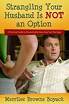
Strangling Your Husband Is Not An Option


I suppose I'd have to recommend this book because I'm dying to talk about it with someone. This book is a quick read. She writes in a very quirky style with lots of question marks and parentheses (hey...a kindred spirit). This book really should just be titled, "How to be a good wife" but admittedly, the title she chose is more catchy. Many of her points are well taken and I'm going to sincerely try to adopt some of them into my own behavior. However, some of her suggestions have a hint of self-promotion to them and she also fails to mention some rather important parts of being a wife (in my humble opinion). Nevertheless, it definitely can't hurt your marriage to read this and it would be fun to discuss. It had a bit of an old-school feel to it in the fact that it suggests you always have your hands and your face as attractive as possible since they are always showing. Basically, have manicured nails and always wear your lip gloss! As much as I mock it, though, I'm sure most husbands would appreciate the effort. Can I wear lip gloss, have rice cereal in my hair and it still count?