Showing posts with label F. Show all posts

Tuesday, November 4, 2008

Flowers For Algernon


This book will get me up to date and hopefully I'll lose that feeling of being behind and unorganized. Maybe. At least in this area of my life.

This was another book I saw on the most commonly banned book shelf at my library. I may have read it before, because I sort of knew the story already. Although if I did, it was when I was much too young to understand the depths of this novel.

I loved it. I really loved it. I even cried at the end, which is so, so rare these days (unless I read Nicholas Sparks who always seems to get me at the end. Blast him.).

Charlie Gordon is a thirty-two mentally retarded man with an IQ of 70. He works as a janitor and errand boy in a bakery and considers his life good and happy because he has lots and lots of friends. He is aware, however, of not being very smart. He thinks if he can learn to read and write properly, he'll be smart and able to understand and participate in what everyone else is talking about.

When an opportunity to undergo an experimental surgery as part of a neuro-psychological study to artificially increase intelligence arises, he happily signs on. He can't wait to become smart.

Algernon is the name of a mouse who has reached unprecedented levels of intelligence following the same surgical procedure. Charlie, the first human subject, mirrors Algernon's success and reaches levels of intelligence far beyond what the doctors behind the study are capable of understanding. Alongside his increased intelligence are emerging emotional capabilities, such as romantic feelings towards women, and troubling memories he was previously unable to remember or understand with his lower IQ, about his childhood and friends.

The entire story is important and poignant. The author, Daniel Keyes, includes part of Plato's, The Republic, to begin the story. Plato writes:

Any one who has common sense will remember that the bewilderment of the eyes are of two kinds, and arise from two causes, either from coming out of the light or from going into the light, which is true of the mind's eye, quite as much as of the bodily eye; and he who remembers this when he sees any one whose vision is perplexed and weak, will not be too ready to laugh; he will first ask whether that soul of man has come out of the brighter life, and is unable to see because unaccustomed to the dark, or having turned from darkness to the day is dazzled by excess of light. And he will count the one happy in his condition and state of being, and he will pity the other; or, if he have a mind to laugh at the soul which comes from below into the light, there will be more reason in this than in the laugh which greets him who returns from above out of the light into the den.

I don't know if he read Plato's words and then wrote this story, or if he serendipitously found it afterward, but it is the perfect prologue. As Charlie adjusts his sight from living in the den of his limited mind to the brighter light of understanding, the growing pains the rest of us have had years to adjust and become accustomed to, are uncomfortable and awkward.

Likewise, at the peak of Charlie's intelligence, when he viewed the world around him in the brightest light possible, Charlie understands the flaws of the experiment that those who developed it were unable to see. With that understanding, the tragedy of watching him lose his grip on so much knowledge feels overwhelming.

As far as being commonly banned, I have no idea, at all, how this could be. The only thing even mildly questionable, to me, is Charlie's struggle to come to terms with the negative sexual conditioning he received from his mother as a boy. As he begins to express the feelings he has for women in general, and specifically towards Alice, a woman he loves, he struggles to understand, beyond theoretically, the complexities of the male-female relationship. While these situations are included, I actually think it's a critical part of the discussion of light and dark. Perhaps not for middle schoolers, but definitely for those of us who live with our own conditioning and judgment.

I highly recommend reading this. Even if you know you've read it long ago for school, read it again as an adult. And then test your own eyes.

Sunday, April 20, 2008

Franny and Zooey


More of a play than a novel, Salinger creates two dissatisfied intellectuals and their fall out with convention resulting from their unorthodox education and childhood.

The book is divided into two parts: Franny's shorter section and a much longer section devoted to her older brother, Zooey.

Franny Glass, the youngest child of the fictional upper class New York family, breaks down after spending the weekend with her pretentious boyfriend, Lane. Lane seems to be the face of everything she decides to be wrong with life. Pretense, insincerity, knowledge without wisdom, and ego, ego, ego contrast drastically with a book she stumbled upon in her brother Seymour's room about a pilgrim who discovers how to pray unceasingly. With her own exposure to world religions at an early age, the book's idea takes hold of her and she ends up at her parent's home, crying and muttering to herself.

Zooey Glass, a somewhat successful actor with contradictions of his own, talks his way through helping Franny. Through his monologues, the reader is able to understand the trouble with knowing so much and trying to reconcile it all in order to successfully function in society. The conclusion he reaches isn't exactly tidy or startling, but the arguments that get both of them there are entertaining and provide much to discuss.

Unconventional with its sparse narrative and long-winded conversations, I was surprised by how much I liked this.

Tuesday, April 15, 2008

The Fiery Cross


The Fiery Cross is the fifth book in a series written by Diana Gabaldon about Clare Fraser, who can travel through time by touching stones (think stonehenge). The first time she time travelled, it was an accident. She travelled two-hundred years backward to the 1740s and met the love her life, Jamie Frasier, a Scottish highlander. Their love story has developed through out each of the books as Gabaldon details the historical setting that surrounds them. In The Fiery Cross, the year is 1771 and the unrest and dissatisfaction of the colonists in the New World are humming. Even though the author uses almost 1,000 pages, the story progresses less than a year through time. That's an awful lot of information, in my opinion, without anything really happening to the characters. Jamie continues to lead, Clare continues to freak out everyone by practicing 20th century medicine in the 18th century, Briana continues to nurse (I couldn't believe how often the author had to point that out to us readers. Her breasts are hardened with milk again????) and Roger continues to be a complete fish out of water. In fact, I believe this book gets read solely because it is part of a series where the reader is already attached to the main characters. Separate it from the other books, and The Fiery Cross is unnecessarily wordy and quite dull.

This book came out four years after the previous book in this series, Drums of Autumn. Four years. I finished Drums of Autumn only few months ago and I was constantly confused by the many, many unimportant names of characters Gabaldon throws at her readers. Who? Is this important?

Turns out, not really. My theory as to why she bothers making it so complicated is that she is trying to convince the masses that these books are much more than fantasy romance, but legitimate historical fiction. She makes her point. Gabaldon clearly has done a lot of research about the living conditions, medicinal remedies, and political atmosphere of the pre-revolutionary war colonies. She included it all and then some. Lots and lots of digression about medicine that Claire Fraser would not have learned or remembered from her med school days. They do not teach microbiology stain techniques, or pathology to the extent that she would be the expert she always ends up being. Gabaldon seems to forget that Clare was a surgeon, and since she rarely gets to do surgery, the author flaunts what she's learned about medicine elsewhere in the book and always uses Clare as her medium. I find it annoying. Clare wouldn't know all of that stuff and making her some sort of superbrain takes away from the realness of her character. Why can't Claire just be wrong...or simply not know? She's pigeonholed her greatest characters. Jamie must be uberbrave. Claire must be ubersmart. Throw in some nookie a few times and you've got your book.

This took way too long for me to read. It simply wasn't very interesting. Until, of course, the very end. Around page 920, she finally threw in some of her good stuff - the time travel stuff. Genuine conflict and not just a side story that takes you somewhere for 100 pages without a purpose. Darn it...I'm going to have to read the next one!

Monday, April 14, 2008

For Whom The Bell Tolls


I cannot remember why I checked this book out. I saw it on something and like to throw in a classic every once in a while. The only Hemingway I've ever read is The Old Man and the Sea in high school. One of my great regrets is not taking any great literature classes in college. Writing papers scared me to death! But, I think some books need the classroom setting to explore and explain why they are so great. This is one of those books.

For Whom the Bell Tolls is a book about the Spanish Civil War. Robert Jordan, an American, is over in Spain fighting with the International Brigades in behalf of the anti-fascists or Republicans. His mission is to blow up a bridge and seeks the aid of a small guerrilla group hiding in the mountains led by a drunken, broken man named Pablo. The book takes place over a four day span and much of the book centers around the theme of death. What is bravery or cowardice? What is a man's life worth in comparison to a great cause?

I had read a little about Hemingway's prose. The most common descriptions are "terse" and "understated". His sentences tend to be shorter and more direct without losing any vividness. They are just more direct. This was no easy read for me. All of the dialogue was written in old English as a direct translation from Spanish. Lots and lots of "thee"s "thou"s and "thy"s. Sometimes, I felt like I was reading the scriptures but without the uplifting part of it:) Whenever the characters were mad at each other or at the situation, a popular phrase used was "I obscenity in the milk of...." which is probably a vulgar profanity but since I don't know what it means, I plead pure ignorance. The dialogue was hard to read. It got easier but this took me days to get into.

Hard or not, I think it's a worthwhile novel. Hemingway took his title from a poem written by John Donne:


"No man is an island, entire of itself; every man is a piece of the continent, a part of the main. If a clod be washed away by the sea, Europe is the less, as well as if promontory were, as well as if a manor of thy friend's or of thine own were. Any man's death diminishes me, because I am involved in mankind; and therefore never send to know for whom the bell tolls; it tolls for thee."

This was Robert Jordan's enlightenment. This was his awakening.

Folding Paper Cranes


I know...another book review...boring.

My mother-in-law started a family book club a couple of years ago where she would buy a bunch of books and then mail them to all of the girls. We were supposed to read it and then mail it on to the next person. In theory, we were all supposed to have different books at different times but eventually all end up reading the same things. Also, in theory, we were supposed to write down our thoughts and leave them in the book. I don't think either of those things happened. Books would build up in certain houses (totally guilty of it), or not read. For whatever reason, I thought it had fizzled out. But, last week, my sister-in-law mailed me two books that I'm assuming are part of the book club. One was Snow Flower and the Secret Fan (which I've already read) and this book.

It's a small book and the first thirty pages totally hooked me. Unfortunately, from about page 31 on...it kept losing me. It's a travel log, op ed of a man who served in the Marine's during World War II and then part of a group of military "volunteers" who were sent to experience what ground zero is like immediately after a thermonuclear explosion conducted in Nevada during the fifties. After witnessing the horrors of nuclear power, he left the armed services, used his GI bill to get a PhD and teaches literature at a small college in Colorado.

The title comes from a peace monument in Hiroshima. After the A-bomb destroyed the city, the survivors were called the Hibakusha. They were broken and wanted to teach peace and built this park to encourage the world to change. One twelve year old girl with radiation poisoning started folding paper cranes. According to Japanese tradition, folding one thousand paper cranes brings good luck but she died before she could finish. Her classmates finished her quest and a monument now stands where children bring folded paper cranes in honor of her.

I appreciated the author's effort. The world needs to be reminded about the devastation that nuclear explosions create...from the immediate carnage to the radiation fallout (the author himself had suffered bone cancer). But the book lacks structure and too often preaches down. His transitions were choppy and inner dialogue corny. I finished feeling disappointed that he had squandered away his chance of using his experiences as something meaningful and motivating. I had hoped for a better book.

Thursday, April 10, 2008

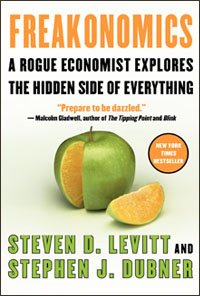
Freakonomics


I can't believe I have finished yet another non-fiction book. I haven't read this much "information" since I graduated from BYU. My book group will be discussion Freakonomics next Tuesday but I think if I wait that long to write anything about it I might forget some of the more interesting things.

This book is written by a journalist, Stephen J. Dubner and an economist, Steven D. Levitt. Neither seem to fit the mold of either of their professions. Levitt takes the principle of incentive and while most economists apply it to finance, he applies it to different social situations that are far more interesting to read about. For example, one chapter is titled, "Why Do Drug Dealers Still Live with Their Moms?" His basic point is that behavior is caused by incentives: social, financial, moral. But it's not just talky talk. I read most of the latest John Stossle book and while I found a lot of his philosophizing interesting I thought some of his data and research was questionable. This guy, however, does not write to whistleblow, moralize, or convert. His sentences include words like algorithm, correlation, causality, equation, data, regression analysis and variables. But those words are just peppered into a very readable book. Believe me, I'm no statitician who enjoys pondering the deeper meaning of standard deviation. Some of his conclusions are surprising and some disturbing. This book has and will ruffle MANY feathers because it really doesn't care if it makes anyone feel good.

The authors state that if morality is the way we would like the world to work then economics represent the way it actually does work. Real Estate Agents, politicians, school teachers, drug dealers, pro-lifers, pro-choicers, parents, sumo wrestlers, klu-klux klan members, bagel eaters -- anyone -- be forewarned. The reasons why you do things are all fair game for this team.