Showing posts with label H. Show all posts

Friday, October 24, 2008

The Host


Stephanie Meyer breaks away from her vampire romance juggernaut to introduce a new story involving alien parasites called "souls"- shiny centipede looking species, that invade planets around the universe, take over the dominant species and, in their altruistic view, make them better.

As they overtake Earth, and secretly begin invading the bodies of humans, relationships are torn apart as loved ones bodies remain in tact, but the person inside is replaced with a higher evolved and peace-loving soul - the only physical evidence of takeover being eyes that are now reflective. Humans struggling to remain human take desperate measures to hide and survive. Melanie Stryder and her younger brother, Jamie, both human, are discovered stealing food when another rogue human, Jared, discovers them. Jared and Melanie form an intense bond and the three become a tight-knit family. When Melanie is discovered by a Seeker, a member of this alien race whose main purpose is to discover, catch and transform any remaining humans, her body become inhabited by a soul who goes by the name of Wanderer. Wanderer struggles to control Melanie's being as flashes of Melanie's memories, feelings and urges all complicate the normally peaceful process. Eventually, Wanderer chooses to leave her peaceful peers and, using Melanie's memories, discovers where Jared and Jamie are now hiding with other human rebels.

First of all, this book should never have been given the title The Host. The host is Melanie and this is not Melanie's story. It is Wanda's (the name Wanderer is eventually shortened to). Melanie is a strong character and certainly influences the direction of the plot, but as Wanda is developed more and more, and establishes her own relationships with supporting characters, the conflict, climax and resolution all focus on Wanda and her journey. Call it The Wanderer. Or The Soul. Or The Beautiful Shiny Centipede-looking thing.

Secondly, the entire story was too long. Wanda, separate from Melanie, falls in love with another human, Ian. But she looks like Melanie and is influenced by Melanie's feelings so she's attracted to Jared. Jared hates Wanda, because she essentially killed the woman he loved. Except that she looks like Melanie. And he is attracted to Melanie. Ian falls in love with Wanda, and her gentle altruism, and becomes convinced he'd be attracted to Wanda regardless of what form she takes - even her shiny centipede form. I don't think so, but Ian was one of those good-all-the-time-guys so...I guess. Ergo conflict. Jared-Melanie-Ian. Jared-Wanda-Ian. Wanda-Melanie-Ian. Wanda- Melanie-Jared. I found this love triangle storyline interesting and complicated. Unfortunately, it was too drawn out alongside several other different story lines, including Wanda's life being in danger from angry humans, Wanda's realization that her species was wrong to eradicate human beings, descriptions of Wanda sleeping on hard dirt (again and again), the angry Seeker who inexplicably won't go away, the plot to get medicine, the plot to get food, the plot to recover other humans, the plot give Melanie her body back and on and on and on. By its end, I was tired. Overloaded with perhaps interesting, but too much, information. The idea of sequels makes me shudder.

If it sounds like I'm Stephanie Meyer bashing, I'm not. I think she comes up with unbelievably original ideas. I simply don't like how she tells them. I think her stories are better suited for movies, or - if she would really, really try - shorter books. There should be a really good reason to justify publishing over 600 pages and this doesn't seem to have one. Except that all parties involved must have known that based on the Twilight series success, this book would sell like hotcakes. Why not make it heavy and charge more?

In the end, this is an average book. Not awful but not great. For me, the ride ends here.

Wednesday, May 21, 2008

Hope Was Here


I feel like the big grown up bully attacking the cute, freckled face kid on the playground with this review. However, as a Newberry Medal Honor Book, the playground kind of turns more into a raquetball court and the kid has to be good to play in it. Consider me goggled, racquet in hand, and donning my wrist sweat bands for serious play.

I really don't understand how this is a Newberry Medal Honor Book. The characters were flat and one-dimensional, the plot predictable and the message was dangerously simplified. I'm left to guess what age group Bauer wrote this for. The abandonment issues the protagonist, Hope, experiences are too mature for young elementary age and older, middle school and high school aged adolescents certainly can grasp the concept of a flawed character or even impure motives. She most certainly didn't write it for a 32 year-old moderate who found the obvious bias of kind-hearted liberal vs. heartless, evil conservative over-the-top and unhelpful for any honest discussion about politics.

I didn't hate it. How can you hate G.T. and his good-guy-leukemia-fighter-town-fixer-upper-cook self? I couldn't. I couldn't even hate Hope, and her far-older-than-actual-sixteen-year-old-mentality even though I never understood her, or her motivation to become so politically involved (because the author never let us know that. She just wrote Hope that way).

I'll take off my goggles now and lob poor freckled face a few serves. It was a nice story. The boy got the girl. The good guy wins. The food was good and hot. The end.

Friday, May 9, 2008

Here Be Dragons


I love to read other people's favorite books. Amy M. recommended this to me, although I don't think she described it as her favorite. Just a book she had read a long time ago that she remembered loving. Having never even heard of it before, I pulled out my super reading powers and gave it a whirl.

First, this is NOT an easy read. The edition I checked out contained more than 700 thin pages of small print. Second, it's historical fiction about a time in history I had no prior knowledge of - 13th century England and Wales. Lastly, there are many, many characters to keep track of, most with unusual names and many being interrelated.

All these difficulties aside, I really enjoyed this story. At its heart is the love story between Llewelyn, Prince of North Wales who later became known as Llewelyn the Great of Wales, and his bride, Joanna, the illegitimate daughter of England's King John. Its development and conflict anchors a story that is forced to span war after war after battle after skirmish after war. Really, these ancient leaders never stopped fighting.

The title, Here Be Dragons, describes a map making technique used long ago. When map makers had limited or no knowledge of certain areas, they wrote, "Here be dragons" on the area with drawings of the mythical creatures to describe this unknown danger.

Both the Welsh people and the Norman-french, who currently held the English crown (really, it's all very interesting) were suspicious of the other and held strong prejudices against any of its citizens. The marriage, which could have and should have brought about peace between the two nations, only put Joanna, who loved both her Norman-French/English father and eventually her charismatic Welsh husband, in the middle.

After I finished reading, I spent a good deal of time researching the accuracy of the facts presented in the book. Many, if not most, are true. Obviously, the fiction comes from the interplay between characters and description of feelings, which can't ever be wholly known, but I think the author did a great job of infusing historical figures with life. The struggles over choosing heirs and the family feuds that any transfer of power creates, were believable and likely.

Most importantly, when applying this history lesson to our current times, I realized human nature doesn't change much...even eight-hundred years later. The names of the countries may have changed but we still believe there are dragons over in the unknown. We still use power and ignorance to fuel our wars and pride and wounded egos to justify them.

Will the human race ever grow up? Time with continue to tell. In the meantime, I'm happy I read this smart, complex and excellent book.

Tuesday, April 15, 2008

Housekeeping


I found this book while researching books on Good Reads. Marilynne Robinson is the author of Gilead, which is a very popular book among readers this season, and just to be that much different (I know... I'm such a stand-out), I read her previous novel, which came as highly recommended.

I can see why book lovers like her. She vividly details each scene. Suddenly, a page is full of the texture of the bedspread and the lighting in the room and the placement of the shoes on a certain side of the bed. But said with such description that you imagine it perfectly.

These are the sorts of things the word lover enjoys. But...alas...I am not so much of a word lover. A word liker, yes. I want my sentences written correctly and a book well constructed, but I'm not going to search out every word and "ah" at a sentence's end because it was pretty.

Ultimately, this book didn't have enough of the stuff I enjoy, mainly a moving story with good character. If I have to describe the story, I'd say it's vaguely specific. So many "why"s and "how"s ignored but so much detail described in other parts. It has a romantic, almost foggy feel. But that might just be because that's what the cover looks like and it stuck with me.

Lastly, I felt the author was too hung up on tying in her title throughout the story. Like, she had the title very early on and kept using it, in all its varieties, so that the reader could feel like the story had a purpose. I'd give examples...but there are too many. It isn't that subtle.

I know there are some of you who love the words. You'd probably love this book. But it wasn't one of my favorites.

The History of Love


I've seen The History of Love on several other blogger's reading lists and after being made aware of the fact that the author, Nicole Krauss, is married to the author of Extremely Loud and Incredibly Close, a book I enjoyed only a couple of months ago, I made a reservation at the library.

In the mood for a romance, when it arrived, I bumped this book past others that have been sitting on my nightstand longer. At first, I was completely absorbed in the writing and Leo Gursky. I even told Emily this book might go on my list of Top Ten favorites. Oh, how I loved Leo's thoughts and his "But." and "And yet." sentences. So stretchy. Those frequently used simple sentences created a narrative of yearning and unfufillment that perfectly expressed Leo's character's disappointment in life.

When it was Alma's turn to speak and disclose, I wasn't nearly so infatuated. Her thoughts and questions lacked the honesty and pain that the much older Leo was able to possess, which makes sense as Alma was only fourteen. Still, I persevered and even enjoyed the minute and slow discoveries she was making.

This book is almost a mystery. The hows and the whys are confusing and it isn't until the end that the missing key is given which opens up the full heartache and confusion of all the characters. Unfortunately, by this time, I was much less enchanted with the entire story as I found way too many parallels with her husband's book that I had already read. They are both about Jewish people divided by a generation who come together through letters. They are both set in New York City with flashbacks to Germany during World War II. They both involve extremely precocious and unnaturally odd children who lose a parent and deal with their grief by setting out on an expedition of discovery. And they both end abysmally disappointing with dysfunction winning over true love. Sigh.

I think I would have loved this book had I read it first or only. Sadly, both books feel tainted to me now. Like, maybe....in a perfect world, I could have enjoyed Singing Bee on NBC. But then Fox came out with Don't Forget the Lyrics. Same idea, different show...I enjoy neither because I don't like copying.

These books don't plagiarize each other or anything, but there are too many similarities for either to be the original and the great books that they are supposed to me. Maybe they need to set their typewriters up in different rooms.

The Hemingway Bookclub Of Kosovo


I didn't decide that I liked this book until the very last few pages. I thought the title was misleading as most of the book had very little to do with the author, Paula Huntley, teaching Hemingway and a lot to do with her own personal thoughts about the pollution, Kosovar's view of Americans, whether or not they had electricity that day etc.

The title comes from a name she gives a group of students she is teaching English to. She only has one Hemingway book, The Old Man and the Sea, which she copies for her entire class. Huntley mentions teaching the book briefly, but it isn't until the very end of this book, that she ties in the great Hemingway story and returns to Kosovo with t-shirts emblazoned with this logo, that I felt like this little book club really existed. It's not obvious and her writing is much more broad in scope than this one classroom experience.

In her defense, Huntley describes this book as accidental. It really is made up of her journal entries that she wrote without any intention of publishing. It wasn't until those receiving her emails initiated the book idea, and she was made an offer from a publisher, that she considered sharing her thoughts with the world. The result is a mixture of mundane, uncensored thought with truthful, personal insight.

I am ashamed to admit that I had to research online about the Kosovo/Serb/Albanian conflict. Of course, I had heard about Milosivec and his war crimes, but I didn't know how the Kosovo conflict related to Bosnia and Sarajevo and that entire region that I was more familiar with. Truthfully, it's complicated and I still don't understand the entire Balkan War. It is about ethnic cleansing and old grudges. It is hard for me to imagine, as a multi-generational American, how such intolerance and ignorance can exist in this day and age when the world is so much smaller and we have access to so much information. How can people still believe that races, or ethnicities, or religions as a whole, actually produce an inferior and worthless human being? This happened seven years ago, and they are still talking with so much generalizations! ALL Serbs, ALL Albanians, ALL Americans etc. Anytime a sentence begins with or contains an "ALL" I bristle. This kind of tragedy is what happens when we fail to see the individual spirit.

Essentially, that is what Huntley much teach these young Kosovar Albanians. That while they have been oppressed and persecuted, they must adjust their thinking. And to accomplish that change, they must have the VOCABULARY to communicate with the world without violence.

The book didn't have much to do with a Hemingway bookclub and I would have loved a more in-depth look at their discussion of the book and the parallels that Huntley ultimately draws from it, but I did end up rooting for Leonard and the Professor and her other students, which is why Huntley decided to go ahead and publish. She wanted us to know these individuals and understand the beauty of the Kosovar soul. I'm glad I got a glimpse

Harry Potter And The Deathly Hallows


I think most of you know how this ends by now so I'll just say that I think....

I wouldn't do that. Maybe I'll do a real review of it in a few weeks but it wouldn't be fair to disclose all my thoughts about something that is best read with the secrets still intact.

I really liked it. I think this entire series is great. I wish my boys could discover them when they turn eleven and then just read one per year as the content, language and plot all mature with the characters. But, mostly, I hope that they enjoy this wonderful world of imagination, magic and mystery as much as their old mom does.

Hero Worship


I am blushing. This was completely mindless, effortless reading. Do NOT interpret that into enjoyable. I don’t know why I kept reading it. It was surprisingly clever, for a romance novel. Alexandra (Andi for short), teaches English at a high school and is a hopeless romantic but can’t find a guy that matches up to her ideals. While reading a period romance novel, supposedly written in the same era as Jane Austen, she finds a wishing stone that just happened to come with the rare edition book. She doesn’t believe in magic but wishes that she could find a guy like Nathaniel, the hero of the book she’s reading. Plop – she finds herself in the story!

Kind of clever but the story that followed was just too dumb to like. If this woman really wanted a guy like Mr. Darcy (who I think this Nathaniel dude was supposed to be like), then she could have acted a bit more classy herself. And the cover? Mortifying.

Why in the world did I just write two (and now three!) paragraphs about this? I am deeply blushing now.

Monday, April 14, 2008

House of Spirits


I hate that I didn't like this book. It's very well received among literary critics and Isabella Allende is considered a giantess of an author. I want to go to a book reading and eat strange delicacies and say things like, "Fabulous. Revolutionary. Extraordinary." Instead, I'm left reading finishing the book in my bathtub saying, "huh?"

Jay majored in Spanish and had to read lots and lots of Spanish literature. He loves books like Hundred Years of Solitude and Bless Me, Ultima. He has persuaded me to read all of these. He bought me this book for my birthday. I'm going to have to start putting my foot down.

There is a genre of Latin American literature called Magical Realism. This genre weaves a plausible story line, set in real life time and real life places with magic. For instance, the first chapter of this book starts with the narrator describing Rosa the Beautiful who had green hair, yellow eyes and transparent skin. And it's not "hair so yellow it looked green"- it's Green! When Rosa dies, she turns into a mermaid!?! Clara, one of the two main characters in the book is clairvoyant and moves tables, salt shakers, predicts the death of people and the outcome of elections. These things are not real but so many books are written like this and I guess I'm supposed to be wowed by the technique. I'm not quite sure what it's purpose it other than making a really goofy story.

Overall, there is a point. Well...several points. One, the evolution of progress both politically and technologically. The author contrasts the rise of Socialism/Marxism against country's history of feudalism and the upper class's puppeted democracy.

The other is the relationships of the characters. There is a similarity throughout all of the romantic relationships that the author probably did on purpose to make some point that I don't understand. She also explores the relationship between brothers and sisters, tenants and landlords and other random supporting characters. I felt as soon as I connected with any of these characters (which was very, very hard to do) the story shifted or the narrator took a detour (all glowingly noticed as well by critics). Rather than applaud with wonder at Allende's craft, I felt the entire story was manic phase after manic phase. Towards the end, I felt like I had been at a party all night meeting strangers and just wanted to go home.

For those more mature than me and interested in magical realism, this book would be perfect!

Thursday, April 10, 2008

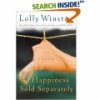
Happiness Sold Separately


This is not a cheerful book. It's not all out depressing but these are not happy people. The title derives from one of the characters' observations about her neighborhood. She lives in Silicon Valley and among very succesful people. The homes and yards are nice but do not make her happy. That is not an available upgrade. The two main characters are struggling with infertility and then infidelity. Mostly a character driven book, the author attempts to portray a tangled situation without a clear protaganist. Everyone is flawed but also someone you might root for. But their choices! Such poor, poor choices after such bad luck.

This is the author's second novel. Her first, Good Grief, I really enjoyed. This isn't as good. I like the writing but there are definitely better tragedies out there. Save yourself the angst.